
fbpx

How To Find Qualified Real Estate Virtual Assistants?

Finding qualified real estate virtual assistants in countries such as the Philippines is easy. But, what are the traits that make them qualified?

Real estate agents have trouble scaling their businesses. As it grows, so does the workload. However, a lot of agents can’t afford to hire locally.

How To Find Qualified Real Estate Virtual Assistants?

So, the best alternative is outsourcing virtual assistants to help with repetitive tasks, documents, and other administrative duties.

With that said, how exactly do you find qualified, cost-effective virtual assistants that can get the job done?

What Makes Real Estate Virtual Assistants Qualified?

When we talk about the qualifications of a virtual assistant – this could mean many things. Even though real estate agents are in the same industry, the pain points of each individual business or firm are different.

So, to answer the question “What Makes A Real Estate Virtual Assistant Qualified?” – you have to think about what tasks take up most of your time. When doing so, try to separate the essential (dollar productive) vs non-essential tasks.

You can do this for one week to give you a baseline for what you need to be done. Log the tasks you’re doing, the time spent per day or week doing the tasks, and if it’s essential or not.

Here’s an example table:
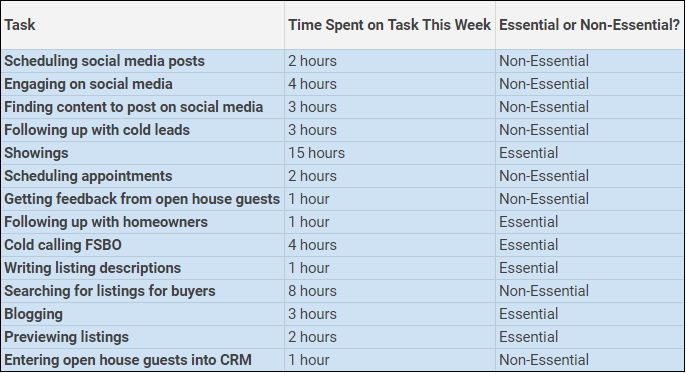
As per the table above, you can see that non-essential tasks like social media, lead generation, cold calling follow-ups, and especially, listing for buyers, take up a bulk of a real estate agent’s weekly workload. Generally, you can easily outsource these non-essential tasks.

Freeing up time means you get more time to focus on core tasks that drive profit for your firm. And, qualified real estate virtual assistants are those with experience or training in the tasks listed above.

Here are some more examples of real-estate tasks you can outsource to a virtual assistant:

  • Broker’s Price Opinion
  • REO Billing and Reimbursement
  • Social Media Marketing
  • REO Administrative Solutions
  • Accounting and Bookkeeping

How Much Do Qualified Real Estate Virtual Assistants Cost?

Pricing depends on the specific roles that a business needs to fill. But, the rates of virtual assistants in the Philippines range from $1.50 on the low end and $20 on the high end.

However, this rate mostly applies to freelance virtual assistants you’d find on platforms such as Upwork. Those with $1.50/hour and below rates are mostly entry-level VAs with little to no proper training.

Meanwhile, hiring from a Business Process Outsourcing (BPO) company in the Philippines ensures that the real estate virtual assistants are qualified and professionally trained. The rate for VAs here ranges from $8.50/hr or higher depending on the task.

You can also hire in other countries such as India. But, when it comes to India Vs the Philippines, the latter does cost less, however, the proficiency in English, accent, and the westernized culture of Filipinos make them a perfect fit in the real estate industry.

Now that you know what makes a real estate virtual assistant qualified and the standard rates, let’s talk about the hiring process.

How To Hire A Real Estate Virtual Assistant

Online Job Boards

There are two primary ways you can source or find a real estate VA. First, you have your online job boards. These are sites such as Upwork and OnlineJobsPh.

Here, you get a list of virtual assistant candidates in several niches including real estate. You get to see their resumes, previous job history, and reviews. Additionally, you can also post job listings so interested candidates can come to you to apply.

Still, there are pros and cons to this approach that we need to consider.

Pros and Cons Of Hiring Real Estate Virtual Assistants From Online Job Boards:

Online Job Boards are simple and effective platforms you can use to find talented virtual assistants. Also, creating an account and posting a job listing takes a few minutes. That said, here are some things you need to think about before hiring from these platforms:

PROS of Online Job Boards

  • Easy account creation
  • Can Source Thousands Of Talent
  • You get to be visible to candidates actively looking for work

CONS of Online Job Boards

  • An overwhelming number of applicants (especially if the rate is above $3-$5 USD)
  • Interviewing Applicants takes up a lot of time for in-house staff
  • The onboarding process can be complicated with everything done virtually
  • Frequent Blackouts

Pros And Cons Of Hiring Through Business Process Outsourcing (BPO)

The BPO industry in the Philippines is massive. Currently, the country is known as the BPO Capital of the World – and for good reason.

Previously, BPOs became synonymous with call centers. But, thanks to advancements in technology, the infrastructure of the industry grew rapidly. Now, BPOs cover a variety of niches from property management, real estate, social media, and more.

Going to a BPO Company means that you only need to talk at a managerial level when hiring virtual assistants. A sales representative would contact you after providing details through their website with the pricing and other important info.

That said, here are some of the pros and cons you need to consider:

PROS of BPOs

  • Access to a wide talent pool
  • 24/7 Operations
  • Access to highly skilled and professionally trained workers
  • Enhanced Flexibility and Cost Savings
  • Updated Equipment / Backup Power In Case Of Blackouts
  • BPOs cover all onboarding processes
  • Ensured Data Security

CONS Of BPOs

  • Loss Of Control
  • Hidden Costs
  • Overdependence

How do I know if I should be looking at outsourcing?

Assess your company’s staffing. Do you experience seasonal volume swings? Have you seen high attrition in accounting, customer service, or administration?

If you answered yes to any of them, an offshore partner could help. Your business will gain much-needed flexibility, allowing it to better handle industry ebbs and flows.

Offshore staffing is easier and more cost-effective than in our customers’ operations. By outsourcing repeatable, data-heavy, redundant, and time-consuming processes, you can increase internal efficiency, staff productivity, and overall cost savings.

Key Takeaways

Outsourcing is the best way you can scale your business. It’s cost-effective, efficient, and frees up your time so you can focus on core tasks.

You can choose to outsource through online platforms but this takes time. Furthermore, you’d need to handle the onboarding process, training, and payroll which can take up even more time.

But, with the help of a BPO, you get to focus on your core tasks and leave the rest of the onboarding process to your service provider. Moreover, you get access to a large talent pool of workers trained by industry professionals with years of experience in real estate.

If you’re ready to start your outsourcing journey, Global Strategic can help with your business needs and give you the Strategic Advantage needed to edge out the competition. Contact us today and learn more about how offshore outsourcing to the Philippines can help your business and future business growth.


Real Estate Lead Generation With Virtual Assistants: Top Strategies

Lead generation is one of the most effective ways to drive profit to your real estate business – and – one of the ways to streamline this is through using virtual assistants.

Traditionally, businesses delegate repetitive non-core tasks to virtual assistants. But, aside from administrative tasks, a virtual assistant can help realty businesses gain leads using simple strategies.

That said, here are some key takeaways you can find throughout the article:

KEY TAKEAWAYS

Virtual assistants are definitely a beneficial asset to any realty firm. But, before thinking about assigning lead generation tasks, make sure that you hire a qualified real estate virtual assistant.

You need a sustainable strategy in order to effectively use virtual assistants for lead generation. Furthermore, there are several ways to find leads including the following:

  • Cold Calling
  • Facebook/Social Media Leads
  • Cold Email Outreach
  • Text Message Marketing
  • Organic Leads

With this in mind, here are the best ways you can utilize your virtual assistants to find leads for your realty businesses.

How Can Real Estate Virtual Assistants Help with Lead Generation?

Lead generation is a crucial component of the growth of your business, but it’s immensely tiresome and time-consuming. Without leads, you can’t offer your product or service, but doing so distracts you from higher-level activities.

Real Estate Lead Generation With Virtual Assistants: Top Strategies

But, you can still get a steady supply of leads with minimal effort and almost automatically if you hire a virtual assistant. And, in the real estate industry, having more time to do core tasks means you get to drive more business, gain more profits, and scale the business faster.

Now, when it comes to real estate, you have to ask yourself what type of virtual assistant you need to hire. You can either go for a VA that specializes in lead generation or a VA that focuses on the real estate niche.

Or, you could find a virtual assistant that specializes in both areas, however, these freelancers often have expensive rates. So, if you can’t afford one yet, you can still do basic lead generation using simple platforms such as Facebook or other social media sites.

Successful lead generation requires attracting prospective prospects and obtaining their details so you can move them through your sales funnel. Depending on your business, lead generation strategies can include:

Cold Calling

One of the most useful methods for getting real estate leads is cold calling, but it requires time, effort, and even more effort to make this work! You’ll need scriptwriting skills if you want to use this method effectively. If you want to make sure something is right, look for these:

  • Opening Spiel – A vibrant tone will help you get the response you want. No one likes a disgruntled caller, especially if they didn’t call first. Be calm and friendly. Add mutual interests to break the ice.
  • Pitch – You don’t have much time when doing cold calls. Explain why you’re calling and introduce yourself. Tell a client what they’ll get. Be concise and emphasize why they need your service.
  • Follow-up Questions – As you can see, this is a major talking point. Pay attention to the customer and inquire about their needs. One of your goals should be to establish a rapport with the customer through their active participation. To put it another way, this will aid in gaining people’s confidence in you.
  • Closing – A good impression should be left with the customer. A prompt conversion is not guaranteed. However, you’d like them to have a favorable impression of you, as you may need to get in touch with them again.

A virtual assistant can help you make more cold calls, boosting your outreach. A virtual assistant can spend all day calling, measuring motivation, compiling statistics, and preparing sales leads.

Facebook/Social Media Leads

Facebook’s Lead advertising is unique if you’re not familiar with them and a useful lead generation tool for any business. They are unique because leads don’t have to visit an external landing page to opt in. Facebook’s Lead advertising makes collecting prospect touch points straightforward, usually only requiring only one click. This gives marketers valuable leads and data.

Cold Email Outreach

Cold email marketing is a cost-effective way to generate leads. In this strategy, you’ll send a cold email, a personalized email message, to prospective consumers you’ve never met.

Text Message Marketing

Text message marketing in real estate is a cost-effective strategy to reach your audience and nurture leads. Short texts that convey the proper message and tone generate trust and authority. Using these tactics and best practices, real estate brokers can utilize SMS to arrange appointments, promote services, send invites, and provide client information.

Organic Leads

Organic leads are a powerful and cost-effective way to generate leads as potential clients typically come to you. There are several ways you can do this starting with becoming a member of property or real estate business groups online such as social media groups, forums, or LinkedIn.

Interact with the members here and make sure to link your site when answering questions, but don’t spam or you might get banned. Ensure that the way you promote yourself is natural.

But, the best way you can get organic traffic is by implementing Search Engine Optimization (SEO) on your site. This means creating content campaigns, creating blog posts, and becoming an authority in the industry.

Conclusion

There are several avenues available to you when deciding how to generate leads for your business. One of the most efficient and cost-effective ways to contact your audience and nurture leads is through real estate text message marketing. Short texts that are well-written and strike the proper tone are extremely powerful in establishing credibility and trust in interpersonal interactions.

Using the following methods and best practices, real estate brokers can effectively utilize SMS to schedule appointments, advertise services, send invitations, and supply clients with necessary information. Email blasts, Facebook campaigns, and good old-fashioned cold calling are also effective strategies that can help generate new leads and convert them to sales. These are all tasks that a Virtual Assistant can help you with, allowing them to be completed in the background while you focus on the core business in the forefront.

If you’re ready to start your outsourcing journey, Global Strategic can help with your business needs and give you the Strategic Advantage needed to edge out the competition. Contact us today and learn more about how hiring virtual assistants can help your real estate business can achieve your goals.

Risks Of Outsourcing Property Management Services

Property Management Outsourcing has several advantages, however, risks should be considered. In this article, we’ll be going through operational risks, principal-agent-related risks, business risks, poor contract designs, and more.

Risks Of Outsourcing Property Management Services

Many praise outsourcing for its ability to transfer fixed and variable costs to an external service provider. Unfortunately, this can result in unforeseen direct and indirect operational costs.

We will define these as transaction costs, principal-agent costs, and operational risks.

Transaction Costs In Property Management Outsourcing

Transaction costs are related to what property management firms should outsource and which service provider should be chosen. Meanwhile, one of the key factors affecting outsourcing is the decision to maintain customer orientation or satisfaction.

This is a business approach that aims to put customers first. But, the introduction of a middleman (ie, the outsourcing service provider) can create barriers.

In a study titled “Understand Crowd Behaviors”, Le Bon and Hughes said:

Because customer service outsourcing adds an independent middle man between the customers and the company, we expect a dissimilar caring attitude from outsourced operators that may not feel as involved as in-house agents would be

On the other hand, some property managers say that being detached from tenants results in better business models, especially rent collection or eviction notices.

This is but one example of how transaction costs can become risks for property management firms outsourcing customer service. Luckily, thanks to advancements in technology and the business process outsourcing industry – training has become faster and more reliable.

Tasks you can easily outsource can include the following:

  • Phone & Email Support
  • Creating / Processing Work Orders
  • Creating Bills / Invoices
  • Reconciling Bank Accounts
  • Screening Property Applicants
  • Generating Status Reports
  • Listing & Online Management

Principal Agent Costs

Principal agent risks and opportunistic behaviors can become byproducts of outsourcing. In a study, Heidi Falkenbacha, Tuuli Jylhäb , Deborah Levyc , Patrick McAllisterd, and Hilde Remoy suggest these risks are commonly classified as: “Shirking, Poaching, and Vendor Hold-up“.

According to the study, Shirking is defined as a service provider being under-invested in the outsourcing services they provide. This could be in the form of a lack of training for employees, management issues, and a lack of communication or trust between them and a client.

Next, Poaching relates to a business process outsourcing provider misusing a firm’s data, intentions, or activities. Generally, outsourcing providers would have different clients. Thus, there are risks involving information leakage and conflicts of interest.

As such, you should choose a service provider that is ISO 27001:2013 Certified. This certification ensures that information security management (ISMS) is practiced within an organization.

Therefore, information stored in computers, data transmitted across networks – printed, written, sent by fax, stored in tapes, disks, or spoken in conversation through phone, and more, are protected.

Operational Risks

Property managers benefit from outsourcing as operational risks can become external. For example, outsourcing can transfer fixed into variable costs. Furthermore, external or remote offshore service providers have dedicated resources for property management.

Through this, businesses can access a large pool of workers that specialize in property management for a fraction of the costs. But, there are always pros and cons associated with operational risks.

As per the study, cost savings was not a key issue in the decision-making process. However, it became clear that there was a trade-off between cost savings and service quality.

Moreover, real estate professionals and property managers expressed issues regarding operational efficiencies. Some of the prevalent concerns are as follows:

  • Property Manager Workload
  • Staff Turnover
  • Quality of Personnel
  • Service Quality

Luckily, the thriving BPO industry in countries like the Philippines ensures services are up to industry standard. Typically, operations within a BPO company follow a specific hierarchy.

Through this, clients can be sure that there’s always someone who oversees the performance of the outsourced workforce.

Do the Risks Of Outsourcing Property Management Outweigh The Benefits?

Currently, the BPO industry is the largest sector in the Philippines. According to Outsource Accelerator, BPO companies employ over a million people nationwide.

Additionally, the industry accounts for 11% of the country’s Gross Domestic Product (GDP). And, with BPO contributing around $30 billion annually, the quality of services has grown exponentially.

Naturally, outsourcing is a major investment for any business. Plus, risks should definitely be looked into. However, with the advancements in technology, training, and experience BPOs had throughout the years – the benefits of outsourcing outweigh the risks.

If you’re ready to start your outsourcing journey, Global Strategic can help with your business needs and give you the Strategic Advantage needed to edge out the competition. Contact us today and learn more about how offshore outsourcing to the Philippines can help your business and future business growth.

Risk Transfer In Outsourcing – Benefits & Drawbacks

Outsourcing Property Management services give businesses the benefit of “risk transfer”. Thus, the Business Process Outsourcing (BPO) provider becomes responsible for system failures and costs that come with it. But, that’s not always the case.

So, should outsourcing be considered risk sharing? In this article, we’re going through the four main pillars of “risk transfer” and how businesses can take advantage of it.

Risk Transfer In Outsourcing - Benefits & Drawbacks

Before getting into detail, let’s first describe what risk transfer is in the context of outsourcing.

Risk Transfer is the contractual transfer of a pure risk from one party to another. This is a part of a risk management and control technique.

Sunil Bakshi, Managing Director and consultant trainer in IT governance and information security, says the four pillars of risk are:

  • Risk Avoidance
  • Risk Acceptance
  • Risk Mitigation
  • Risk Transfer

Risk Management Options In Outsourcing – The Four Pillars Of Risk

Risk Avoidance

When companies transfer risk to an outsourcing partner, they share it. Example: financial loss. As such, a minor premium might transfer a susceptible company’s financial loss risk to an insurer.

Meanwhile, a group’s premiums and losses are allocated using a predetermined formula, which is called risk sharing or risk distribution. Appropriately, transferring risks and sharing risks are comparable or similar responses to risk.

Among the best practices to avoid risk is to ensure that you and the third-party vendor understand each other clearly. So, clients and vendors need to clearly define what the requirements and limitations are.

A simple way to achieve this is by sending requirements documents to vendors and giving them time to review them in detail. Once done, vendors should already have a list of questions, concerns, or recommendations.

Afterward, the client’s company should invite vendor managers and client team members responsible for contributing to different areas of the requirements documents.

Risk Acceptance

Accepting risk is when a business or individual decides a risk’s potential loss isn’t high enough to spend money avoiding it. An example of this in outsourcing comes in the form of “Loss of Control“.

Outsourced processes or services may cause managers to lose control of their process technology and quality standards. Unfortunately, the consequences can be dire.

That’s because when a company outsources tasks previously undertaken by its own employees, quality, production schedules, and contractual disputes can occur. Managers often accept this risk when outsourcing.

Balancing out quality for cost-effectiveness then becomes a manager’s primary task when considering outsourcing. Luckily, with advancements in technology – the gap between cost-effectivity and quality of work has shrunk exponentially.

Now, BPO companies handle training and quality control of a client’s outsourced workforce. That way, risk acceptance becomes minimal as loss of quality is mitigated.

Risk Mitigation

Business Managers have considered outsourcing as a risk transfer/risk sharing response since the popularization of outsourcing practices. As such, organizations shifted risks too difficult to manage internally due to cost and resources.

Moreover, the outsourcing partner becomes responsible for sourcing talent that meets a business’s skill requirements. But, although this argument is valid, outsourcing should not be considered a risk-sharing option for the entire business process and core activities.

That said, businesses, especially those only starting to outsource, are advised to outsource repetitive, non-dollar-productive tasks. These include data entry and other back office services.

To learn more about these tasks, check out the article below:

What Can You Outsource To The Philippines? – Top Outsourced Services

Risk Transfer

Think of outsourcing as a contractual transfer of risk from one party to another. “Shall assume…” and other indemnification clauses are common in contracts.

Your company, for example, makes extensive use of software tools in its day-to-day operations. There are two types of software: on-premises (also known as “on-premises”) and cloud-based (also known as “on-premises”).

The outsourcing company’s risk management strategies are critical to your organization’s success. Norman Marks, a leading name in risk management says management will be unaware of how the third party controls risk. Even if the merchant was doing everything right, you won’t be able to claim perfect innocence when a major issue arrives.

For this reason, businesses need to ensure that the vendor they chose to outsource services to is transparent on how they handle risk management within their own company. The third-risk party’s management practices must be evaluated by organizations – a good example would be ISO.

Conclusion

Businesses, especially property management, shouldn’t look at outsourcing merely as a way to save on operational costs. There are clear risks that need consideration.

Additionally, both vendors and clients should clearly discuss how to approach those risks in order to gain a mutually beneficial relationship. Clearly, outsourcing takes work. But, with the right partner, it becomes a valuable asset to any business in the long term.

If you’re ready to start your outsourcing journey, Global Strategic can help with your business needs and give you the Strategic Advantage needed to edge out the competition. Talk to us today and learn more about how offshore outsourcing to the Philippines can help your business and future business growth.

Benefits Of Outsourcing REO Administrative Services

The benefits of outsourcing Real Restate Owned (REO) administrative services are a game-changer. If you’re in the real-estate business, then you probably know that REOs are the best way to get deals.

But, the number of administrative tasks that come with it can definitely take a toll. As it stands, dealing with REOs is already a grueling task that involves finding the right asset manager that could find REOs for you, looking through properties listed on Multiple Listing Services (MLS), and so much more.

Benefits Of Outsourcing REO Administrative Services

For this reason, real estate agents that want good deals through REOs sacrifice a lot of time and effort. However, the reality is that most of these tasks are easily automated. Luckily, that’s where outsourcing comes in!

With outsourced REO Administrative Solutions, you can gain access to the following services:

REO Administrative Services You Can Outsource

With a good outsourcing partner, you can easily outsource the bulk of your REO-related tasks. Common ones include MLS Entry, Uploading Listings to Websites, Scheduling, Customer Service, and more.

Here’s an in-depth look at the REO tasks you can easily outsource to virtual assistants:

MLS Entry

Multiple Listing Services (MLS) and other real estate technologies have been developed through the investment of millions of dollars by real estate agents. These services and technologies make real estate transactions more effective.

Bank and Asset Manager registration can take months. Global Strategic’s REO MLS Listings save realtors, appraisers, and contractors valuable time. Partnering with Global Strategic for REO Listing will give you access to hundreds of banks and asset managers, giving you more opportunities quickly.

Scheduling

The best way to save precious time and get more done is through efficient scheduling. And, if you’re outsourcing scheduling tasks to a virtual assistant, you can save money doing so compared to in-house staff.

There are several types of scheduling tasks you can outsource that can include:

  • Scheduling Buyer Tours
  • Scheduling Personal Appointments
  • Preparing For Open Houses
  • Maintenance Schedules

Listing Maintenance

An REO or real estate maintenance vendor is hired to protect and secure the property. Initial property services, debris removal, cleaning, securing, winterization, and ongoing services.

Landscape, mechanical equipment and infrastructure, shared areas of buildings, and exterior elements are also maintained. Damage, water leaks, code violations, and property upkeep are avoided.

So, with the number of things that you need to consider related to maintenance, doing all these yourself won’t be efficient. Instead, you can assign a virtual assistant to handle all the maintenance-related processes for you.

Document Filing

Any business has some form of back-office duties that need to be done. But, with is definitely emphasized with REO. The processes involved can take up a lot of time, and with that, a lot of documents.

Customer Service / Support

A virtual assistant covering the phone and email customer service could have helped you convert the lead. Hubspot says customer retention is cheaper than acquisition. Additionally, a 5% increase in customer retention can potentially lead to double profits.

Hiring a virtual assistant to help with customer service opens up several revenue streams for your property management business. Customers will spend 300 percent more time with you if you have good CSR, giving you a competitive edge.

How Can Outsourcing Help You With REO?

Outsourcing lets you cover your entire loan portfolio. Servicers don’t have nationwide networks of vendors and salespeople to sell REO assets. Servicers need a partner with access to experienced local vendors nationwide.

The right REO asset management partner can meet the servicer’s needs across their entire loan portfolio, from property preservation to HOA monitoring and fee settlement.

Your REO outsourcing partner can begin mitigating risks sooner if they start early. The right partner will use a nationwide network of experienced third-party vendors to quickly get REO properties ready for sale and back on the market. As soon as you have a property to sell, begin REO asset management.

Conclusion – Should You Outsource REO Administrative Services?

At this point, we hope you got an idea of the benefits you get from outsourcing REO administrative services. Right now, thousands of real estate businesses are outsourcing to get an edge against their competition – we can help you with that.

Global Strategic provides individualized REO administrative solutions in order to fulfill the requirements of each unique client. As such, we ensure that your company’s operations are managed in an effective and efficient manner, precisely to your specifications.

If you’re ready to start your outsourcing journey, Global Strategic can help with your business needs and give you the Strategic Advantage needed to edge out the competition. Learn more about how offshore outsourcing to the Philippines can help your business and future business growth.

What Can Property Managers Automate?

Automation is increasing efficiency in many industries, and property management is no different. Property managers can choose to automate a variety of tasks, though the reality is that only a small percentage of a manager’s tasks can be left to automation. Despite this, if done correctly doing so can improve performance and efficiency drastically.

In this article, we’re going to take a look at the services managers can automate and the ways to do so. Furthermore, we’ll also discuss the differences between full automation and outsourcing tasks to a property management virtual assistant (PMVA).

What Can Property Managers Automate?

In most cases, the easiest tasks to automate are billings and handling tenant-related processes or work orders. Thus, you can choose to hire a PMVA or buy software that helps you automate the tasks for you.

But as a rule of thumb, property managers should start outsourcing or automating “non-core activities”. For the majority of managers, leasing and looking for the right location and business can be a taxing activity.

In addition, tenant-related documentation and screening of prospective tenants can take up a lot of time. These tasks are all important – but they don’t drive revenue – thus, they are considered “non-core activities”.

Meanwhile, another task that’s sure to take up time (mostly unexpectedly) is maintenance and other tenant concerns and complaints. You can set up an answering machine or service for this that says, “press 1 for complaints, press 2 for maintenance concerns”, and so on.

But every issue or emergency is unique to each tenant and that’s why you’d often need to handle it yourself. Luckily, property managers can hire virtual assistants to help with customer concerns.

This type of outsourcing allows managers to hire a call center service to handle customer support duties among other tasks that are suitable for remote work processing.

Take note that listing units, payment collection, and dealing with complaints can all be automated but they need human input.

Automate These Property Management Tasks

If a process needs to be repeated multiple times, it can be automated. Although simple in nature, these minute tasks can become a burden, especially when scaling up your business.

That’s why you should start automating the following tasks:

Rent Collection

Rent collection automation isn’t difficult. You’re behind if you don’t accept online rent payments. You could mistakenly limit your owners’ renter pool. Automated software lets renters pay online. The software makes rent collecting hands-free unless tenants insist on writing checks.

The software can remind tenants when rent is due. You can then let them pay immediately. You can give an incentive and choose to receive rent collecting alerts. Automation handles the payment and nonpayment alerts.

Renewals

Automating renewal is easy. Say you enter a new tenant’s lease terms and information. The software sends prewritten emails to property owners on the renewal date.

It may contain renewal instructions and fields for the owner to complete. Your automated software will email the tenant a renewal contract to sign. You can also tell the software to send reminders and personally monitor the process.

Maintenance Requests

Maintenance requests can be automated through software or outsourcing. Your maintenance staff or company can be alerted of move-outs so the unit can be ready for a new tenant quickly.

Automate low-priority maintenance calls. Tenant calls, messages, or submit a maintenance ticket. Your chosen crew will receive a work order from here. When the bill arrives, the job’s done.

Tenant Reminders

Automation simplifies notifications. Forget emailing and messaging everyone about a parking ban or freeze-watch.

Your contact lists are continually updated as you add or remove renters. You can send a notification message to the correct person with one click.

Should Property Managers Automate or Hire Virtual Assistants?

Now that we know the basic tasks we can automate – it’s time to discuss whether or not it’s better to buy software or hire virtual assistants. There are two ways we can define “automation” in this context: “all-in-one automation” and “process by process automation”.

The basic “all-in-one” automation is a ready-made solution that digitizes business processes. Property management is used in maintenance requests, billing, tenant management, and more. Unfortunately, the software still has operational limits.

Meanwhile, “process by automation” means that you take a hands-on approach to automate services. As such, property managers need to analyze their internal business process and specify their exact needs, and short-term and long-term goals.

All-in-one automation software can become too generic. As such, it’s better to find software that specializes in a specific task you want automated.

Still, the fact remains that using software still needs manual labor. Plus, opting for a fully automated system means sacrificing human input. And, in an industry such as property management, organic human interaction become a necessity.

In the end, you’d not only struggle with learning completely new software, but you’d also need in-house staff to do the work for you. You may also have to pay more in expenses as some licenses for automation software only allow the use of one computer.

Automate Property Management Tasks with Virtual Assistants

Hiring virtual assistants is a good middle ground when it comes to automating property management tasks. For starters, getting expensive software still requires you to learn it and have somebody operate it.

Additionally, the best property management automating software may charge monthly renewal fees for a license. Eventually, this is going to stack up. Moreover, you still need time to train in-house staff on how to utilize it.

But, partnering with an outsourcing company not only gives you automation options but also provides you with a massive boost to your workforce. As such, you gain access to an entire talent pool with each virtual assistant having their own skills, so you don’t have to compromise quality.

Here are some of the tasks you can automate with the help of PMVAs:

If you’re ready to start your outsourcing journey, Global Strategic can help with your business needs and give you the Strategic Advantage needed to edge out the competition. Contact us today and learn more about how offshore outsourcing to the Philippines can help your business and future business growth.

Evaluating Outsourcing Partnerships In Property Management

If property managers want to start evaluating potential outsourcing partnerships, then a measurable benchmark should be defined.

Generally, businesses hiring offshore service providers are looking to save costs. However, qualitative metrics such as employee and customer satisfaction must be taken into account.

Evaluating Outsourcing Partnerships In Property Management

According to Collier’s study, the decision to outsource is based on two factors – value proposition and market-based outsourcing.

The study states that Value Proposition dictates the cost savings, efficiency, customer support, employee satisfaction, and reduction of capital expenditures. Meanwhile, market-based outsourcing covers the question of “In-house vs Outsourced services“.

Can the external service provider (Business Process Outsourcing) be better, cheaper, or faster than the internal? Keep in mind, that cost shouldn’t be the only deciding factor when it comes to hiring offshore service providers.

That said, property management businesses need to ask the following questions before looking into outsourcing:

  • What are the key success factors?
  • How can these success factors be measured?

Here is a benchmark that property managers can look into

Value and Cost Savings for Client / Revenue Generation for Service Provider

Here’s an example of why you should benchmark value and cost savings.

Example Case Study #1

Let’s say the client wanted to cut costs, but its CEO forbade any strategy that compromised work quality. The company knew labor arbitrage in offshore outsourcing would reduce costs the most. It then compared onshore and offshore outsourcing providers’ quality, performance, and prices.

Example Case Study #2

After three years of significant changes in property management outsourcing solutions, the client in this case suspected it was overpaying. It used benchmark data to renegotiate the contract to include new services not available when they signed their original contract.

Pro Tip:

To compare costs, you must know what these tasks cost in-house. What is your business currently spending? What costs would you incur if you did everything yourself? More staff or equipment? Consider everything and itemize process costs.

Next, do the same cost analysis for outsourcing. To compare providers, you’ll need quotes.

Efficiency (Speed & Process of Service Delivery)

One of the best ways of evaluating potential outsourcing partnerships is by looking into the speed and process by which their services are delivered.

We can also define efficiency as how fast an offshore staff can start working post-training. If the offshore staff is already trained, that’s already an added bonus.

However, there will be times clients use company-specific tools and processes. As such, benchmarking can be measured through the time it takes to train and onboard your remote workforce.

As a rule of thumb, outsourcing property management services should provide the following:

  • Phone & Email Support
  • Creating / Processing Work Orders
  • Creating Bills / Invoices
  • Reconciling Bank Accounts
  • Screening Property Applicants
  • Generating Status Reports
  • Listing & Online Management

Client Satisfaction

Usually, one of the best ways to look into client satisfaction is by reading testimonials. Furthermore, take a look at case studies to see specific ways how service providers helped previous clients.

Blogspot says that client satisfaction can be measured through a scale of 1-3, 1-5, or 1-7. Next, all you need is to add all scores and divide by the number of respondents to get your client satisfaction score. CSAT is the most common customer satisfaction measurement.

Workplace Quality Optimization

Typically, this benchmark can be measured by how much time and resources your in-house staff can save and streamline if repetitive tasks are outsourced. As mentioned earlier, outsourcing doesn’t only cut labor costs – it should also help streamline profit-driving tasks.

Regrettably, property management, as lucrative as the industry is – carries a lot of back-office responsibilities. This holds true especially when dealing with tenant-related processes.

So, if these repetitive tasks are starting to overwhelm in-house tasks, ask yourself how much time could be saved through outsourcing. Additionally, ask what you can do with that extra time.

Trust Between Client and Service Provider

Naturally, outsourcing means that you’d need to trust a remote workforce to handle integral tasks. But, more than this, you need to trust that the outsourcing provider you choose shares your business’s philosophy.

Taking this into account, how can you build trust with a service provider?

Building Trust Should Be A Priority

As mentioned above, you can start building trust by ensuring that the client and service provider’s philosophy and work ethic match. Moreover, both the client and service provider needs:

  • Honest Feedback
  • Creating realistic goals and expectations
  • Having objective means to measure success
  • Learning how to compromise
  • Ensure dependability
  • Provide consistency
  • Ensure ethical outsourcing practices

Who Oversees Performance Of Outsourced Workforce?

Choosing freelance property management virtual assistants means you have to oversee performance and the overall onboarding process. On the other hand, choosing a BPO company means you only have to do minimal work.

Partnering with a BPO means that there’s already communication at the account manager level. Basically, clients can communicate with the operational managers of the service provider.

Afterward, the managers assign a team to handle the account. A team can include workers with varying skillsets depending on the client’s needs.

Operational directors/managers have supervisors under them that oversee overall operations at a macro scale. And, under the supervisors are what’s called “Team Leaders” (TL).

Team leaders can’t hire or fire employees, unlike managers. They’re often asked for input, though. A good team leader has excellent communication skills, empathy, and the creativity and organizational skills to set clear goals and divide labor.

Some teams define goals and divide labor collaboratively. The team leader sets both with team input. In both cases, a team leader must get everyone on board with the tasks.

Team leaders keep tabs on the progress of their subordinates. Client satisfaction and efficiency are a priority for them. Next, the TL creates reports to senior management or supervisors to document their performance.

Conclusion

Outsourcing is an effective way for property managers to increase productivity and efficiency in a cost-effective manner. And, for small businesses that want to streamline their operations, outsourcing provides a way to strengthen your workforce for a fraction of the cost.

Global Strategic can help with your business needs and give you the Strategic Advantage needed to edge out the competition. Learn more about how offshore outsourcing to the Philippines can help your business and future business growth.

Best Practices For Outsourcing Property Management

Outsourcing property management tasks to an offshore workforce provides advantages – but, it also comes with risks. Luckily, there are best practices you can follow to help your business utilize outsourcing to its full potential.

First, identify the business’s pain points. Ask what tasks your business is struggling with. Then, pinpoint which of those you can easily outsource.

Best Practices For Outsourcing Property Management

The common tasks property managers outsource include the following:

  • Phone and Email Support
  • Processing Work Orders
  • Creating Bills / Invoices
  • Reconciling Bank Accounts
  • Screening Property Applicants
  • Status Reports
  • Listing & Online Management

Once that’s done, look for avenues where you can hire a good offshore workforce. Generally, this comes in the form of Business Process Outsourcing (BPO) companies from countries like the Philippines or through freelancing. If you want to learn more about these concepts, check out our article below:

Costs Of Outsourcing To The Philippines: Pricing Structure & Fees

Still, as we discussed earlier, outsourcing comes with challenges and risks. So, before you start, it’s part of the best practices to consider the following:

  • Time zone differences
  • Minimal control over the offshore workforce
  • Language and cultural differences
  • Slow turnaround time
  • Onboarding and Training

Now that we’ve understood the basics, let’s take a look at the best practices for outsourcing property management services:

Outsourcing Best Practices For Property Management

Dip your Toes in the Water before Diving In

There’s no denying that outsourcing saves up on labor costs. Studies suggest businesses can save up to 70% if done effectively. However, this is still a big investment for both the short and long term.

As such, most would recommend outsourcing relatively small tasks that are simple in scope. Through this, you can give a grasp of the capabilities of your service provider.

Then, if you’re ready, you can start scaling up the tasks you want to be done. Furthermore, you get access to highly-skilled and professionally trained workers.

Clearly Define Project Scope & Limitations

Chances are outsourcing companies already have an idea of what they could help you out with following an initial meeting. But, it would be up to you to clearly define what you need from them.

For this reason, you’d want to create a work plan for the task you want to be outsourced. Moreover, you’d want to have a way to record milestones and deadlines.

That’s where time tracking apps come in. But, your outsourcing partner should also have their own time tracker for the full-time employees that are assigned to you.

Build Relationships & Partnerships With Managers

Most businesses stop outsourcing following bad experiences with freelance offshore remote workers. Naturally, this is understandable. Trying to find the perfect property management virtual assistant to handle your tasks takes time, money, and a lot of effort.

Meanwhile, if you go the BPO route, you can talk with industry leaders, and managers, and start building long-term relationships with them. According to studies, successful outsourcing ventures stem from working relationships among management.

This way, you don’t have to worry about VAs going AWOL, equipment issues, and training. Every resource, labor pool, and equipment a BPO has, you now have access to. As such, it’s empirical to build relationships with management so any problems can be taken care of with ease.

Choose Industry Experts In Property Management

Naturally, you’d want an expert in Property Management to handle your outsourcing needs. This is true even if your business only needs to outsource back office solutions.

One thing to consider is the time it takes to train virtual assistants in handling property management back office tasks. Meanwhile, if you’re partnered with a BPO company that already has experts in the field, onboarding VAs won’t be a hassle.

Training VAs generally takes between a few weeks to a few months. Your mileage may vary especially if you choose freelancers. However, even with effective training, that won’t guarantee trustworthiness.

Here’s a quick checklist to see if an outsourcing partner would be right for your business:

  • Has years of experience and matches your specific business needs
  • Fast Turnaround Time
  • Utilizes the latest tools and technologies
  • Communication that is clear and simple
  • Extensive quality checks
  • Security and confidentiality
  • Full intellectual property rights

Pick Trustworthy Virtual Assistants

As stated above, you need to have virtual assistants who won’t up and leave once they get paid. Trustworthiness is invaluable when talking about outsourcing.

With the help of a good outsourcing partner, your business is sure to have virtual assistants that won’t go AWOL. You’ll have full-time VAs working for you that are managed by your BPO partner.

Take Cost Into Consideration

When you outsource, labor costs will be much lower compared to hiring locally. But, taking cost into consideration is still one of the best practices when outsourcing property management.

Even at the low end, some Filipino virtual assistants work for as little as $3 – $5 an hour, which has its own set of advantages and drawbacks. For entry-level positions, you can expect to pay anywhere from $16 to $20 per hour to hire a local employee, while higher-skilled positions can cost even more.

Additionally, you should also consider government-imposed fees. Still, the Philippines has one of the best policies for foreign businesses that want to outsource. Because of the Special Economic Zone Act, the Philippines can offer tax exemptions to international businesses.

Research The Culture

Aside from skills and individual personalities, culture needs to be considered when hiring offshore virtual assistants. For instance, there may be huge cultural differences that could affect work. Those have to be discussed so both parties can land on a beneficial compromise.

On the contrary, culture can also become a benefit. Filipinos, for example, have a culture of being hospital, friendly, and hardworking. Furthermore, they also have one of the most westernized cultures in Asia.

So, in most cases, the culture in the Philippines, especially when it comes to work, can definitely add value to your business.

Before Asking For A Quote, Answer These Questions

  • Do you know what to outsource?
  • Do you have a task or project outline, manual, or clear instructions?
  • Task/project outline
  • Expectancy
  • Project cost/budget (billed by the hour or project)
  • Date-specific deadline
  • Requirements
  • Needs
  • Who will manage your outsource contractor or firm?
  • If this task will be repeated, can the initial outsource contractor prepare a “manual” or outline? You’ll have a resource you can use again in the future, either as part of an operations manual or to pass on to another outsource contractor if the first one doesn’t work out.

If you’re ready to start your outsourcing journey, Global Strategic can help with your business needs and give you the Strategic Advantage needed to edge out the competition. Contact us today and learn more about how offshore outsourcing to the Philippines can help your business and future business growth.

Outsourcing Maintenance Services For Property Management

Property Managers are starting to get into outsourcing services such as maintenance and repair, eviction notices, and other tenant-focused support.

In this article, we are focusing on outsourced maintenance services and how it benefits property managers. Furthermore, we’ll give a rundown of the Pros and Cons of Maintenance Outsourcing – and more importantly, how to make it work!

Outsourcing Maintenance Services For Property Management

For the most part, outsourcing is seen as an effective way to save on operational costs. However, the best property managers know that saving on costs shouldn’t be the primary factor to consider.

What you’re looking for when you outsource services – especially maintenance – is a balance between costs and how it can optimize or streamline your operations.

When done successfully, maintenance outsourcing reduces costs by ensuring issues aren’t prevalent. And, when problems do arise for a tenant’s property, then the maintenance and repair process can be somewhat automated. As a result, property managers don’t have to do hands-on work unless a major concern is raised. In turn, more work can be focused on profit-driving tasks.

So, before we continue, let’s first discuss what exactly is Maintenance Outsourcing.

What Is Maintenance Outsourcing

In essence, subcontracting a process, such as product design or manufacturing, to a third-party entity is known as outsourcing. Maintenance outsourcing is the process of contracting maintenance work to a third-party organization.

Outsourcing maintenance services is one of the best ways to lower operating costs. Additionally, outsourcing may be the greatest option for managers facing staffing issues, training budget cuts, aging maintenance workforces, and hard-to-find skilled labor pools.

The benefits of maintenance outsourcing are obvious: budget flexibility, optimization of people and tools, cost savings in employing specialist staff, and training, to name a few. Moreover, the outsourcing structure can be simply altered to meet your maintenance requirements.

It’s occasionally a major factor for Property Managers opting for outsourcing as a maintenance plan. Many businesses have had significant success using outsourcing to boost their competitiveness.

Pros And Cons of Outsourcing Maintenance Services

Contractual and Outsourced Maintenance Services are becoming an increasingly popular trend with Property Managers. Generally speaking, maintenance management services can be done in three ways: In-House, Hybrid In-House and Outsourcing, and Full Outsourcing.

In this part of the article, we’re going to list important advantages and disadvantages that go along with outsourcing maintenance functions for Property Management businesses. Particularly, we’ll be referencing factors such as operational cost, work quality, expertise, equipment, risk reduction management, and core business functions.

Advantages Of Maintenance Outsourcing

  • Operational Cost Savings – Most industries are driven by cost management, which is a major reason for outsourcing. Wages and benefits for in-house employees (such as pensions, medical coverage, and vacation) may have become too expensive for the corporation to subsidize. A contractor’s capacity to stretch up and down faster than in-house workers affects cost; also, the contractor absorbs hiring costs. These and other financial liabilities associated with labor are assumed by an outsourced contractor.
  • Flexibility – An outsourced contractor can give flexibility in supplying the appropriate personnel level and desired skill set rapidly, with less cost and time investment, as well as providing expertise that may not be available, or is insufficient, among in-house staff. This knowledge will also benefit the work quality. It allows you to use specialized services as needed rather than investing in building in-house skills that aren’t required on a permanent or ongoing basis.
  • Tools and Technology – An outsourced contractor can give people that are well-versed in the latest technologies without the organization having to provide training to in-house employees or incurring the cost of purchasing the technology/equipment. The same is true for specialized tools and equipment, in that the contractor must provide the tools and equipment necessary to complete the operation.
  • Ability To Focus on Core Business Functions – Outsourcing maintenance work gives property managers more time to focus on dollar-productive tasks. Instead of handling tenant concerns and other issues, things get automated as you outsource maintenance services.

Disadvantages Of Maintenance Outsourcing

  • Loss of control – Although outsourcing the maintenance function may save money, there are drawbacks to working with contractors, such as the host company’s inability to control and educate the workers directly. Another example is that meeting all of a client’s needs, such as personnel flexibility or craft availability, within the host company’s standards may be challenging for a service provider. Additionally, the client and contractor may have opposing techniques, management styles, and ideologies, which can lead to disagreement.
  • Staff Turnover – In-house personnel is more likely to have more years of experience at a facility than contractor employees, and they are more familiar with the business and its expectations. Outsourced employees, on the whole, do not have as much loyalty to the organization as in-house employees. As a result, their intellectual knowledge of a site’s maintenance function, equipment, and business strategy is more easily lost if/when they depart, because their loyalty is shakier.
  • Overlapping roles – Within a client and contractor organization, roles may be duplicated, increasing overall costs. Overlapping duties and responsibilities within the maintenance organization can result in inefficiencies, contribute to the appearance of too many supervisors and not enough workers, conflicting priorities, and confusion.

In-House Vs Outsourced Maintenance Services

Determining whether to undertake maintenance in-house or hire a contractor is a constant cause of consternation for many businesses. The debate over insourcing vs. outsourcing maintenance is a strategic one that should be considered based on a variety of factors before making a decision.

The finance of in-house and outsourced maintenance can be complicated in some organizations because funds may be controlled by numerous departments and budgets. In general, three approaches to maintenance management will be considered: in-house personnel, a hybrid of in-house and outsourcing, and pure outsourcing.

How To Make Outsourcing Maintenance Work

To make this outsourcing venture work, you need to identify the two major types of maintenance work – Commodity Maintenance and Skilled Maintenance.

Contrary to popular belief, outsourcing is not a “plug-and-play” option where you could just pay for service and expect things to run smoothly. There’s always going to be effort required for managers to ensure that they can reap the rewards of their outsourcing decision.

With that said, let’s get into the two types of maintenance work you need to know before outsourcing your services:

What Are Commodity Maintenance Activities?

Homeowners will clearly have their own expectations of how they want to upkeep their property. Usually, you see this in the form of basing gardening, cutting the law, and in general – making the property look acceptable or what the kids call “Aesthetic”.

Now, why is this type of maintenance important? The answer is simple – it’s easy to do! And, when you have something that can be easily done then it’s perfect for outsourcing.

Tasks like blowing leaves out of the lawn, trimming bushes, or removing snow off the driveway don’t take much skill to do. So, with that in mind, it would be better to outsource these tasks rather than to use in-house maintenance technicians for this.

And, looking at it from an isolated perspective, it might seem small enough that you wouldn’t need to outsource. However, multiply those simple jobs with a couple of dozen clients and you got yourself a problem.

That said, when looking into outsourcing this type of work, here are a few things you need to look out for:

  • scope of work
  • qualifications
  • expertise
  • schedule
  • quantifying quality measure

What Are Skills-based Maintenance Activities?

I’m referring to skilled labor and taking inventory of existing multi-craft technical maintenance abilities in mechanical systems, electrical distribution systems, hydraulics and pneumatics, welding, machining or fabrication, and carpentry when I say skilled maintenance.

Managers considering outsourcing maintenance should strive to strike a balance between cost and service that optimizes operations. Managers can cut maintenance costs by hiring a contractor with more expertise and abilities than in-house resources can give if this approach is successful.

If you’re ready to start your outsourcing journey, Global Strategic can help with your business needs and give you the Strategic Advantage needed to edge out the competition. Contact us today and learn more about how offshore outsourcing to the Philippines can help your business and future business growth.

Outsourcing Tenant Screening – How To Make It Work

Property managers are looking into outsourcing the bulk of their administrative tasks – Tenant Screening being one of them. But can outsourced remote tenant screening really work?

Thanks to modern technology, we have come to a point where you can outsource tasks such as Tenant Screening to Property Management Virtual Assistants. Obviously, there’s a steep learning curve, but, thanks to years of development, training VAs are easier than ever.

Outsourcing Tenant Screening - How To Make It Work

Outsourcing isn’t a new trend. In fact, in the past decade, several industries have heavily invested in automating their operations through outsourcing. Modern outsourcing encompasses a wider range of professional services than in the past when most outsourcing was in manufacturing.

In the new “work anywhere” era, outsourcing has become a cost-effective solution to staffing and operational problems and has become a go-to for businesses across pretty much all industries- including Property Management.

In this article, we’re going to show how to make outsourced tenant screening work.

Why Is Outsourcing Tenant Screening So Effective?

It’s not a question of whether or not hiring offshore tenant screeners works. For years, Property Managers have used this as a tool to streamline their business. In reality, the question you should be asking is what can I do to make outsourcing work for me? Naturally, there are many answers to this question. However, there isn’t a one size fits all solution.

So, the first step is to find a good outsourcing company that has years of experience in Property Management. Next, you need to discuss a strategy on what you can automate so you can focus on more important aspects of your business.

With that in mind, here are the key reasons why Outsourced Tenant Screening Works:

You Get to Automate Repetitive Tasks

Documentation that comes with screening tenants is simple enough. However, one of the downsides of scaling up a Property Management business is the amount of documentation that goes with it. More properties managed = more tenants coming in. With the number of applicants, you can’t afford to waste time sifting through dozens of potential applicants.

Luckily, with the help of outsourcing, all tenant-related processes are handled through Property Management Virtual Assistants. Thus, the only time you’d even need to step in is when there’s a major issue that you personally need to attend to.

Emotions Won’t Get in The Way

Hiring an offshore property management service that can handle tenant screening means that property owners don’t have to interact with tenants.

If you’re a hands-on landlord, then there will be times that you get attached to your renters or potential renters. That’s absolutely a good thing! But there will be times when your kindness gets taken advantage of. As a result, screening tenants for the purpose of renting out a property may be compromised. Your tenants have no idea who their property manager is. You can rest assured that the tenant screenings you receive from a property manager are unbiased.

Red Flags Are Easier to Spot

As a first-time landlord, you may not be able to identify tenant red flags. Even if you don’t see this as a disaster, it can lead to you renting out your property to people who aren’t worthy of it. Outsourcing can help with this.

An experienced property management team is a wise investment because they are used to dealing with a wide range of people. When it comes to screening tenants, they’ll know how to look for red flags in their application and how to avoid approving tenants who might end up causing you problems in the future.

That will save you a lot of time, money, and effort in the long run.

Outsourcing Tenant Screening Saves You Money

Because outsourcing your tenant screening process can save you money, it is a good idea to do so. In fact, you can save up to 15% of your total costs by outsourcing this type of work.

That may not seem like a lot at first, but it can quickly add up.

Checking a tenant’s credit and criminal history is a common practice in the rental property industry. Thousands of dollars can be wasted if you have to run a large number of them as part of a rental evaluation.

While working with a real estate manager can cost you more money in the long run, you can save a lot of money by purchasing in bulk. You can save a lot of money down the road by getting wholesale rates on background checks and tenant screenings by outsourcing those processes.

How To Effectively Outsource Property Applicant Screening?

As mentioned earlier, there are several ways to make outsourcing tenant screening work in your favor. The first things you’d need to consider are the prevalent issues that go along with tenant screening. So, if an outsourcing service can handle these issues, then you’re in the right direction.

That said, here are the common issues faced in tenant screening:

Instant Background Checks Equals More Errors

There are a lot of tenant screening companies that promise “Instant” background checks. However, getting those immediate background checks may lead to several errors along the way. A key detail about the applicant can be missed out on or skimmed through.

Most tenant screening services are designed for profit. Achieving immediate gratification means satisfying your emotional brain. When it comes to tenant screening, most people don’t have an idea of what goes into the process.

Here are some of the negatives of Instant Tenant Background Checks

  • In some databases, instantaneous searching is not possible
  • All databases have their share of mistakes and false positives.
  • Your report will have less data if you choose an immediate solution.

The information in your report is a carbon copy of the data in the database. Errors in the database will appear in your report as well. Because no one is checking the work for accuracy, important information is left out and false information is inserted.

Compliance Issues

The Fair Credit Reporting Act (FCRA) outlines the rights of individuals whose credit is being checked. As a tenant applicant, you have recourse under the Fair Credit Reporting Act (FCRA). 

Eviction Data Issues

In any tenant background check, eviction data is the most important piece of information. The tenant’s first eviction is the most terrifying because of this.

The second eviction is like going through a haunted house for the second time. It’s a strange feeling. Second evictions are much less frightening because there is no longer any fear of the unknown.

The first thing to look out for is a red flag. In the basic packages of some tenant screening services, eviction data isn’t included. It is our opinion that the most critical information should be included in the simplest form of the report.

There is no way a tenant screening company can serve the landlord’s interests if they do not include information about evictions in their reports.

How Should You Screen Tenants?

There are several things that you need to look into when screening tenants. Because of this, the following must be looked into to do a thorough screening process:

  • Credit History
  • Rental History
  • Criminal History

Along with this, you also have other questions that you need to consider such as:

  • Ask the previous landlord if the tenant was disruptive, noisy, late with the rent, or otherwise harmful to the property.
  • Employers, past or present. A company’s employees with good work ethics are more likely to pay their bills on time. Additional proof of employment and income can help support the placement of a resident with exceptional ability.
  • Referrals from the author’s own experience. References that aren’t related to business or housing can also be useful in gaining insight into a tenant. Keep an eye out for references who praise the applicant excessively or who repeat the same sentiments about him or her.

Should I Look into Outsourcing Tenant Screening?

Tenant screening can be a challenge for landlords. It can be tedious, time-consuming, and difficult to conduct background checks on potential renters.

There are many people who don’t have the time or knowledge to thoroughly screen potential tenants to ensure that they will pay their rent on time and take good care of the rental property before they sign a lease.

Your rental properties may be better served if you outsource your tenant screening process to an outside company!

If you’re ready to start your outsourcing journey, Global Strategic can help with your business needs and give you the Strategic Advantage needed to edge out the competition. Talk to us today and learn more about how offshore outsourcing to the Philippines can help your business and future business growth.